
Affiliation: Total Brain, A SonderMind Company
Correspondence: licensing@totalbraindatabase.com — Founder, Total Brain and Total Brain International Database
Abstract
Human Brain Cognition and Emotion are becoming an increasingly present source of inspiration within the AGI field. This shift is visible across frontier labs and leading researchers. In the past half year, DeepMind proposed a cognitive framework for AI, Anthropic identified emotion concepts that impact model performance and reasoning, and Yann LeCun parted ways with Meta where he had served as chief AI scientist, motivated by his belief that current methods are not sufficient and that human-level intelligence requires cognitive architectures that have more in common with perception-action loops, predictive processing, and neurobiology.
This paper presents the Total Brain Integrative Intelligence (TBII-AGI) Framework as a complementary alternative framework to expand and deepen the existing direction that the field is going in, from the perspective of a large human brain function and cognitive performance database — drawing on decades of applied neuroscience with data from the standardized and integrative Total Brain International Brain Database of human cognitive, emotional, and neurophysiological data (ERP, HRV, imaging), encompassing 7 billion datapoints in 15 validated paradigms across the cognitive spectrum, including habituation, startle, attention, memory, emotion regulation, executive function, and markers across the normal, mental health, and peak performance continuum.
The TBII-AGI Framework proposes key components for brain-aligned AGI that include emotion-cognition interactions, unconscious cognitive processes and cognitive bias, human signatures for all-round high performance akin to AGI, and whole-brain dynamics with high temporo-spatial and performance single-trial granularity. We provide database exemplars that demonstrate 'smooth' and 'jagged' human performance models akin to the Google DeepMind Cognitive Taxonomy for testing AGI ability; the impact of emotion mindsets on cognitive efficiency and similarities in Anthropic's Emotion Concepts and LLM performance reporting; similar cognitive bias in the human database and a VLM model on the same task; and brain ERP components to learning in an executive function hidden maze task akin to some of the ARC-AGI-3 benchmarks.
1. Introduction
The race to develop true Artificial General Intelligence (AGI) comprises the forefront of current AI development — to build AI with the ability to understand, learn, and flexibly apply its intelligence to any intellectual task that a human being can perform. This extends beyond the capability of current models that are very good at learning individual tasks, but poor at generalizing those intelligent capabilities to new challenges or contexts.
AGI development is currently experiencing a period of pivot and change. Recent years have been dominated by the Scaling Hypothesis — the hypothesis that AGI could be achieved by adding more data and compute to Transformer-based models (Kaplan et al., 2020). While this approach has yielded AI models that are in many ways highly capable, this approach has to date failed to yield true general intelligence in AI models, and developers are now hitting a plateau of diminishing returns. As a result the industry is undertaking new approaches, including pivots towards architectures that are informed by principles of human brain function. Google DeepMind has recently established a new cognitive taxonomy framework for AGI testing based on human cognition benchmarks (Burnell et al., 2026), and Demis Hassabis has stated that ideas from neuroscience will be increasingly indispensable as both a roadmap for AI research and a source of computation tools (Hassabis et al., 2017). Anthropic's research shows emotion-like processes act as causal control systems within AI model performance, not just surface features (Sofroniew et al., 2026). Meta's former Chief AI Scientist Yann LeCun believes that achieving human-level AGI requires machines to mimic the way that human brains build common sense, persistent memory, planning, and reasoning from physical interaction with the world — capabilities that current LLMs fundamentally lack (LeCun, 2022).
The current approaches to AI development and evaluation have produced systems of remarkable capability, yet have not given rise to the kind of flexible "integrative intelligence" that characterizes human brain capabilities, or true artificial general intelligence. An expanded human brain-based view of what constitutes general intelligence has never been more prescient or applicable for the next era of AI development.
1.1 Cognitive Capacities of AI
François Chollet's ARC-AGI benchmark series for evaluating AGI capabilities operationalizes general intelligence as the efficient acquisition of novel cognitive skills from minimal training signals (Chollet, 2019). The subsequent ARC-AGI-2 innovation lies in making memorization impossible: each task presents a novel rule, and success requires in-context generalization. Top scores currently plateau at around 20–50%, underscoring the persistent gap between current AI and human-level generalization (Chollet et al., 2025). ARC-AGI-3, released in 2026, translates this taxonomy into interactive, game-like maze environments in which agents must plan, model, explore, and adapt in real time. Current frontier models score below 1% of human performance (ARC, 2026).
Google DeepMind's recently released cognitive framework for AI "Measuring Progress Toward AGI: A Cognitive Taxonomy" describes today's AI systems as fundamentally jagged intelligences — being very good at some things, but very poor at others (Burnell et al., 2026). A classic example is ChatGPT-4o performing at the 90th percentile on the bar exam, while being unable to count the number of "r"s in the word "strawberry". Google DeepMind's Cognitive Taxonomy approaches the goal of general intelligence by organizing AGI evaluation around ten core cognitive faculties: Perception, Generation, Attention, Learning, Memory, Reasoning, Metacognition, Executive Functions, Problem-Solving, and Social Cognition (Burnell et al., 2026).
Critically, the taxonomy is candid about its scope: it addresses the "what" of AGI cognition — the functional requirements of a generally intelligent system — rather than the "how," the underlying factors that give rise to these cognitive capacities. It is also limited in scope to evaluating AGI's progress relative to human cognitive capacities and does not encompass insights from human general intelligence that can inform the development of artificial systems. The scope is further limited to cognitive processes, and does not encompass emotion-related capacities, with social cognition included predominantly for the complexity of cognitive processes involved, rather than a larger exploration of the interplay between cognition and emotion.
1.2 Emotion and AI
Relationships between emotion and cognition are emerging as being highly relevant for large language models (LLMs) and their cognitive performance. LLMs can appear to exhibit emotional reactions, and their behavior can change in ways somewhat similar to those expected in humans (Sofroniew et al., 2026). While these emotions are presumably learned from the large array of human content the models have been trained on, Anthropic have recently reported on a wide array of situations in which Claude's cognitive behavior and decisions were impacted by concurrent emotions being expressed (Sofroniew et al., 2026). For example, artificially steering Claude toward desperation increased the likelihood of giving a seemingly reasonable solution to an unsolvable programming task, a behavior known as reward-hacking. Conversely, increasing Claude's activation in the "calm" direction reduced this reward-hacking behavior. As Jack Lindsey, head of Anthropic's "Model Psychiatry," has put it: "What surprised us was how significantly Claude's behavior is routed through the model's emotion representations." (Knight et al., 2026).
1.3 The Brain and AI
There is an emerging recognition of the potential for aspects of human brain function to inform new approaches to AGI development. A prominent recent example is Yann LeCun's November 2025 departure from his 12-year role as Chief AI Scientist at Meta to pursue human-level AI, which LeCun believes requires a radically different form of training — one informed by ideas such as predictive processing and perception–action loops, and analogous to specific regions of the brain: "The perception module corresponds to the visual, auditory, and other sensory areas of the cortex… The intrinsic cost module corresponds to structures in the basal ganglia involved in rewards, including the amygdala… The configurator may correspond to structures in the prefrontal cortex that perform executive control and modulate attention" (LeCun, 2022).
This aligns with the origins of AI design and its building blocks in neural network architecture. Anthropic's Sparse Autoencoders approach aims to identify interpretable features within LLMs associated with particular concepts (Sofroniew et al., 2026). OpenAI's Sam Altman has framed the entire AI endeavor as "building a brain for the world" (Altman, 2025), and Google DeepMind's Demis Hassabis has long held that ideas from neuroscience can be indispensable as both a roadmap for AI research and a source of computation tools in AI development (Hassabis et al., 2017).
1.4 Total Brain Integrative Intelligence Framework for AGI (TBII-AGI)
The current framework paper expands and deepens these approaches with the Total Brain Integrative Intelligence Framework for AGI (TBII-AGI). This is a complementary expansion from the perspective of the first Standardized Integrative International Human Brain Database (Total Brain Database). Assessments span more than 15 cognitive-emotion capacities across the spectrum of unconscious, conscious, and peak-performance aspects of cognitive function in a 7-billion-data-point normative and clinical database. The TBII-AGI Framework draws on this dataset and decades of peer-reviewed neuroscience (over 300 publications) to propose new evaluation dimensions that the current ARC-AGI-3 and Google DeepMind Cognitive Taxonomy and other AGI architectures do not fully incorporate.
Traditional AI and LLM research and benchmarks do not place enough emphasis on understanding, comparing, and translating human biological and artificial dynamical information processing. Despite humans possessing an efficiency of learning and generalizability of acquired skills that AI models are not capable of. The Total Brain Framework expands these traditional approaches with a complementary framework to provide insights into training new models for AGI capabilities that truly span the breadth of human unconscious-conscious cognition and emotion, and into integrating these capacities to achieve complex goals such as those outlined in ARC-AGI-3.
2. Total Brain Integrative Intelligence Framework for AGI (TBII-AGI)
2.1 The Total Brain International Database
The Total Brain Framework is informed and powered by the Total Brain International Brain Database — the first standardized, integrative international human brain database.
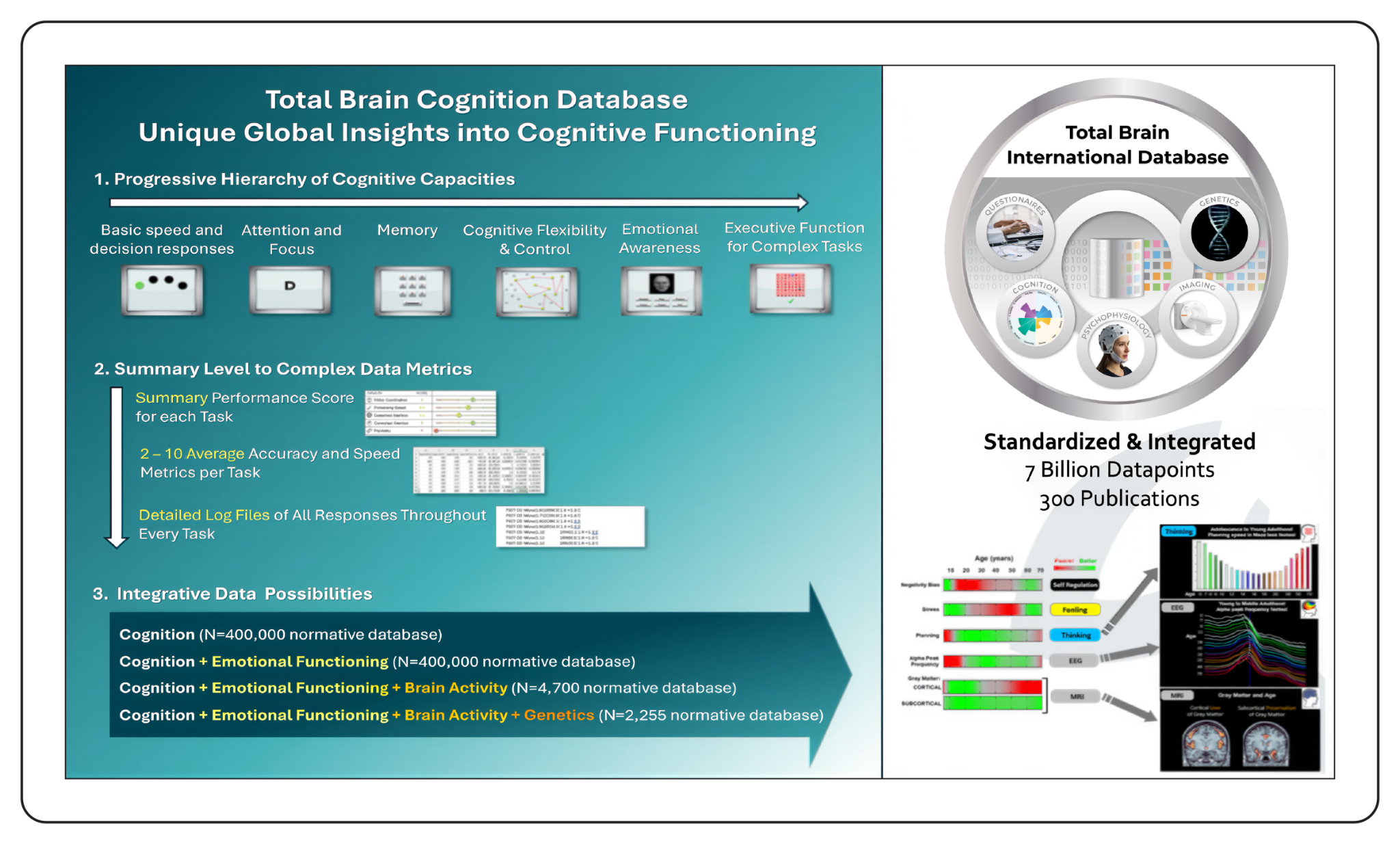
The assessments and data metrics in the Total Brain International Database have been designed to capture the core processing elements along the spectrum of brain processes, following a continuum from unconscious through to conscious and long-term self-regulation processes, and in a way that reflects hierarchical processes and draws upon fundamental aspects of the evolutionary biology of the brain. The tests within the assessments are designed to measure core pillars of function that underlie all cognitive and emotional processes. The metrics provide an integrative framework both across this continuum and across levels of function (imaging, functional brain-body dynamics, cognitive performance, and self-report).
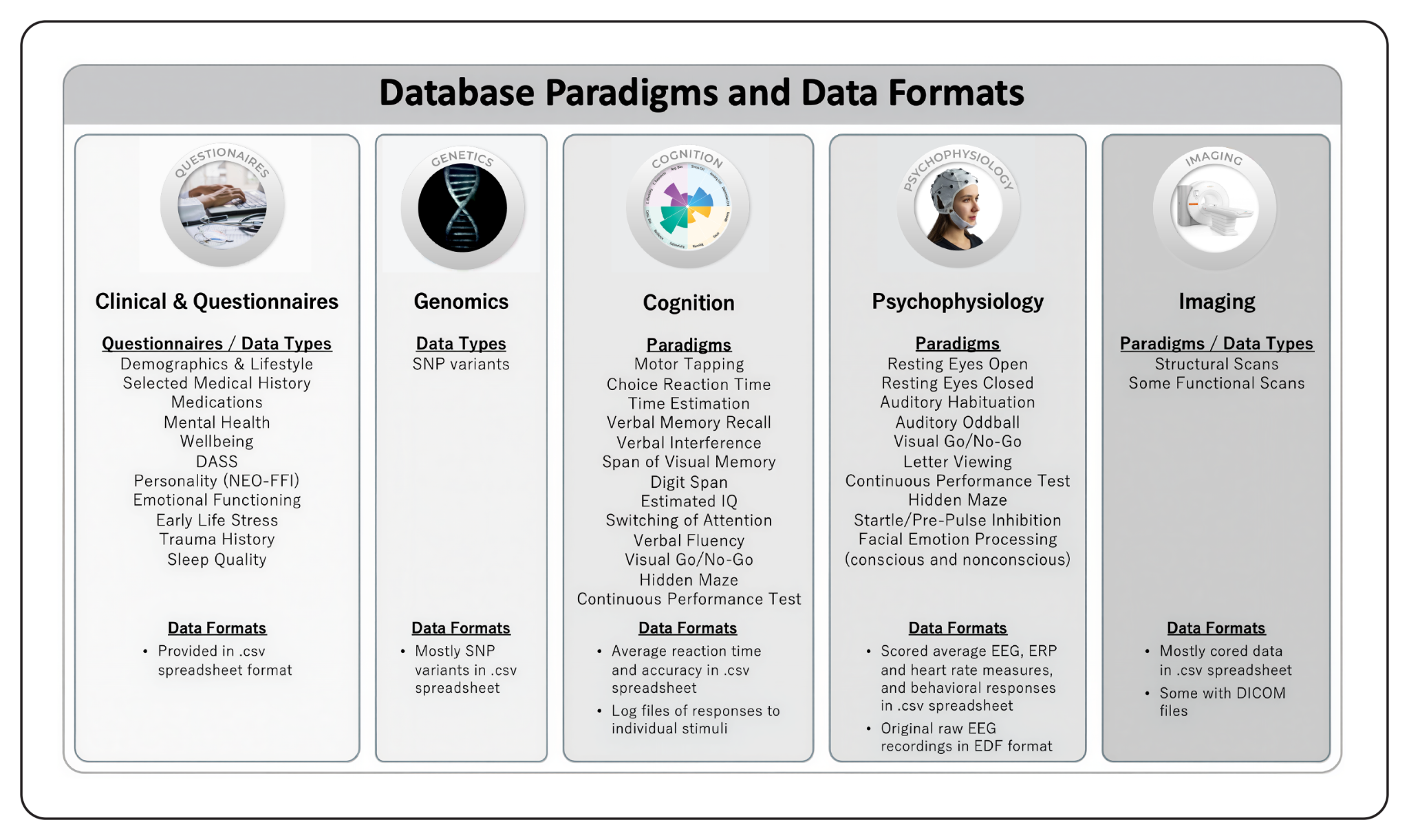
The Total Brain Database is comprised of assessments from standardized 20- and 40-minute modular online cognitive and mental-health assessments, as well as lab-recorded psychophysiology battery (EEG/ERP, autonomic), that were deployed to hundreds of thousands of participants across normative, ten clinical, well-being, and peak performance settings. The platform measures more than 15 capacities that align with and expand current AGI testing, including: habituation, startle response, sensory-motor speed, decision-making speed, accuracy, and learning profile on every paradigm; sustained attention; echoic-working-recognition-recall memory; emotional cue recognition; executive function (including a digital maze); and unconscious-conscious emotion measurement in face-processing paradigms (including unconscious subliminal perception processing). These, along with a spectrum of more granular metrics, allow not only for the current requirements of next-level AGI assessment but also for the addition of a range of AGI-relevant metrics to cognitive response time metrics, providing deeper temporal-spatial insights into the underlying mechanisms of these cognitive measures. All of these metrics are available in normative subjects across the age range of 6–100 years old, and across mental health (in 10 disorders, including anxiety, depression, addiction, ADHD, PTSD), well-being, resilience, and peak performance. The Total Brain International Database has data from over 500,000 individuals with 7 billion data points, and over 300 associated peer-reviewed publications.
In addition to testing AGI — the focus of this paper — the Total Brain framework and data provide context to inform the development of AGI that best interconnects with human brains.
2.2 Total Brain Integrative Intelligence Framework for AGI (TBII-AGI)
The Total Brain Integrative Intelligence Framework (TBII-AGI) expands and adds value to AGI development and testing by integrating the core components that human brain function and performance can provide, including emotion-cognition interactions, conscious and unconscious processes, and the role that human brain dynamic systems can provide.
| # | TBII-AGI Component | Description | Total Brain Advantage |
|---|---|---|---|
| I | Broad Cognitive Performance Profile | A hierarchical suite of 15+ cognitive capacities spanning speed, attention, memory, control, flexibility, executive function, and emotional processing — mirroring the Google DeepMind cognitive taxonomy. | N = 400,000+ with standardized task performance and log-file data, covering the full lifespan from ages 6–100. |
| II | Emotion–Cognition Integration | Explicit operationalization of the interaction between emotional processing and cognitive performance across conscious and unconscious channels. Emotions act as guidance and motivational systems for human behavior, signalling significance and directing cognitive resources. | Emotion tasks embedded within the cognitive battery; DASS and BRISC self-report scales co-administered; emotional brain ERP data in N = 4,700+ subset. |
| III | Unconscious Processing | Measurement of subliminal (non-conscious) stimuli processing and its effect on subsequent cognition — both unconscious and conscious processes seamlessly integrate to give rise to human intelligence by rapidly evaluating new information and automating past learnings. | Unique psychophysiology battery with millisecond ERP resolution; Stroop and emotional bias tasks capturing unconscious interference. |
| IV | Brain Dynamics | Time-resolved electrocortical signals (EEG/ERP) reflecting the underlying neural architecture of cognitive processing — including resting state and task-evoked activity at millisecond timescale, down to single-trial level. | N = 35,000+ psychophysiology sessions across clinical and normative groups; resting EEG plus 10 active paradigms. |
| V | Total-Brain View & Genetic Integration | A brain-aligned AI perspective encompassing whole-brain dynamics and emotion-cognition interactions — providing a practical model for building AGI systems that work in ways that fit human brain function. Includes genetic variants (SNPs) integrated with brain function and cognitive performance. | N = 4,003 with genetics, brain function, and cognition in the same individuals. Enables multi-level modeling of intelligence. |
The five posited components for brain-aligned artificial general intelligence in the TBII-AGI are as follows:
- Utility of Human Brain Data for AI — We posit that human brain data can provide uniquely insightful data for new approaches to training for AGI.
- Brain-Informed Training for AGI itself — Achievement of AGI may necessitate specific training for AGI itself, over and above training for each of the individual skills contained within AGI benchmarks. Essentially, that the "whole" of AGI may be more than the sum of its parts.
- Emotion-Cognition Interactions — Emotion and cognition are inextricably linked in the human brain, interacting and informing each other. Emotions act as guidance and motivational systems for human behavior, signalling significance of incoming information and thereby directing cognitive resources (Tyng et al., 2017; Williams et al., 2008). 'Gut feelings' play a strong role in complex decision-making, acting as an efficient short-cut to incorporate previous learning experiences into current decision-making (Bechara et al., 2004).
- Unconscious and Conscious Processes — Both unconscious and conscious cognitive processes seamlessly integrate to give rise to the efficiency of human intelligence, by rapidly evaluating new information for cues of potential threat or significance, and also automating past learnings into unconscious processes which then prime subsequent conscious thinking (Kahneman, 2011; Rowe et al., 2007).
- A Total-Brain View — We posit that a brain-aligned AI perspective encompassing the whole-brain dynamics of emotion-cognition interactions of human intelligence will provide a practical model for building AGI systems that work in ways that fit human brain function, enabling stronger alignment and enhanced performance between machine capabilities and human brains.
TBII-AGI aligns directly with emerging AGI evaluation approaches by assessing core capacities. It expands these approaches by capturing how they operate over time and captures both smooth performance and breakdown patterns. It adds granular, dynamic, and personalized learning metrics that track how quickly and effectively systems adapt. It also links these capacities to underlying brain function using temporo-spatial measures such as ERP, HRV, MRI, DTI, and fMRI. These signals clarify what each capacity represents, how it operates, and how the capacities can be optimally measured and applied in real-world conditions.
We posit that while some aspects of neural architecture underlying human cognition may not be relevant for general intelligence in artificial systems, there will be many aspects of human general cognition and its underlying strategies and neural mechanisms that will offer novel insights for training artificial systems to achieve AGI. We further posit that this will be particularly important for the purposeful training of AGI for broad intelligence across cognitive domains and skill sets, rather than simply combining a range of cognitive skills trained independently. We highlight that placing equal emphasis on emotion processes and unconscious, as well as conscious processing, will be key to achieving true AGI.
3. Four Examples of Total Brain TBII-AGI Framework Differentiation in AGI Testing
The TBII-AGI Framework allows a spectrum of specific empirical research questions to be tested in the Total Brain dataset. We present four data insight exemplars below. Additional AGI-aligned data insights from this unique database will also be presented in future papers.
The four data insight exemplars presented here are based on the following four research questions proposed for investigation with the Total Brain normative database:
- What distinguishes individuals who perform consistently and all-roundedly across diverse cognitive domains from those with jagged ability profiles? Can human profiles be established that are equivalent to the 'jagged' and 'smooth' AI performance patterns in the Google DeepMind Cognitive Taxonomy?
- Emotion-Cognition relationships. Can Emotion-Cognition relationships in humans help to inform the impact that LLM emotion states may have on model performance?
- Can an LLM perform the database color-word Stroop task, and are there equivalences between the LLM performance and human database performance on the same task?
- Can event-related potentials inform patterns of learning from trial-and-error that reflect better executive function and problem-solving?
These questions are directly analogous to core questions in AGI research. Can a short interaction with an AGI system predict its performance profile across diverse task types? Do the internal computational dynamics of a system (analogous to ERP) differ between systems with smooth versus jagged performance profiles, even when surface accuracy is equated?
ARC-AGI-3's action-efficiency scoring is an important step toward insights into whole-brain and brain dynamics. It penalizes brute force and rewards parsimonious hypothesis-driven exploration. The TBII-AGI Framework extends this logic across a broader range of dimensions, asking not only "Did the system reach the correct solution?" but "What processing dynamics generated that solution, and how would those dynamics change under pressure, bias, or social complexity?"
3.1 Jagged and Smooth Cognitive Profiles
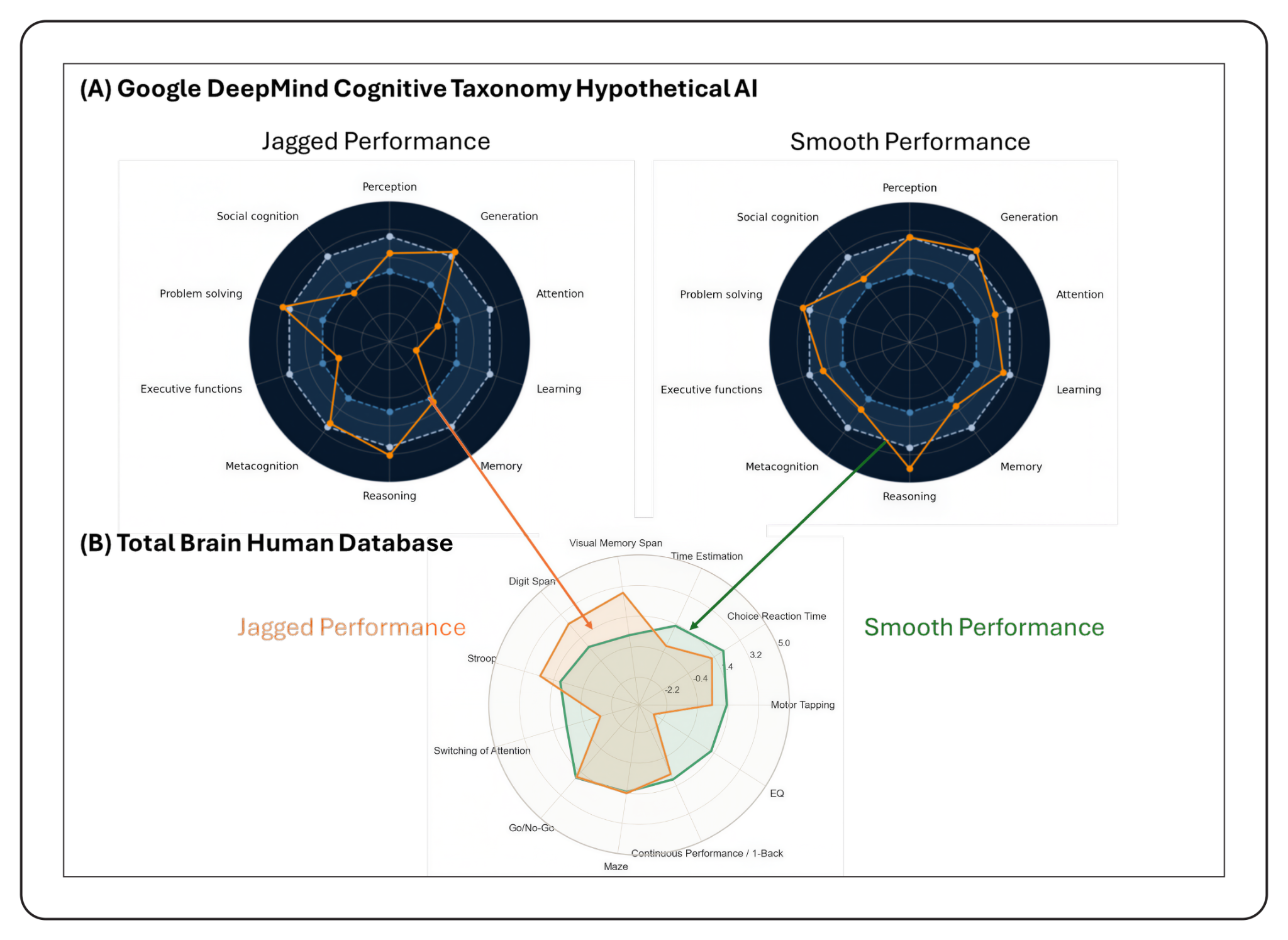
Expanding Google DeepMind's Cognitive Taxonomy and the recurring problem of AI jaggedness, in this exemplar we use the database to investigate what jaggedness looks like in humans and how human performance data may inform smooth, general performance in AI.
The Google DeepMind Cognitive Taxonomy Framework proposes 10 domains of cognitive functioning most relevant to intelligent behavior and AGI benchmark testing: Perception, Generation, Attention, Learning, Memory, Reasoning, Metacognition, Executive Function, Problem Solving, Social Cognition. The TBII-AGI Framework and spectrum of data within the Total Brain International Database cover key aspects of all 10 of these domains, and further expand these domains by capturing what the brain does and how it dynamically responds under load, conflict, and learning, using reaction time, errors, and adaptation.
| Google DeepMind Cognitive Domain | Total Brain Database Aligned Cognitive Constructs |
|---|---|
| Perception & Generation | Hierarchical sensory-motor audio-visual perception and response. Includes: habituation, auditory oddball, speed and choice response time, letter and face perception. |
| Attention | Sustained attention, attention switching, and selective attention. |
| Memory | Working memory, short-term, and delayed memory. |
| Learning | Maze learning (trial-error adaptation), list learning rate. |
| Executive Function | Cognitive flexibility, hidden maze (includes task closure, focus, and learning). |
| Reasoning | Planning, interference control. |
| Metacognition | Self-report cognitive and emotional awareness. |
| Problem Solving | Maze task. |
| Social Cognition | Emotion awareness (task-based, including bias and unconscious processes); self-report social skills, empathy, and social intuition. |
Table 2. Direct Mapping and Alignment of Google DeepMind Cognitive Domains and Total Brain International Database.
A core component of AGI is the ability to 'smoothly' show high performance across all aspects of cognition, as opposed to the 'jagged' performance profile of having high performance on some types of cognition but average to poor performance on others. Identifying similar profiles in human performance enables the unique aspects of each profile to inform training for AGI models.
Within the normative Total Brain Database, the high-performance population was defined as those with mean normalized scores across all cognitive domains in the top third of the normative distribution. Of this high-performance cohort, those with high standard deviation across tasks were considered to have 'jagged' performance (orange dots), and those with low standard deviation across tasks to have 'smooth' performance (green dots).
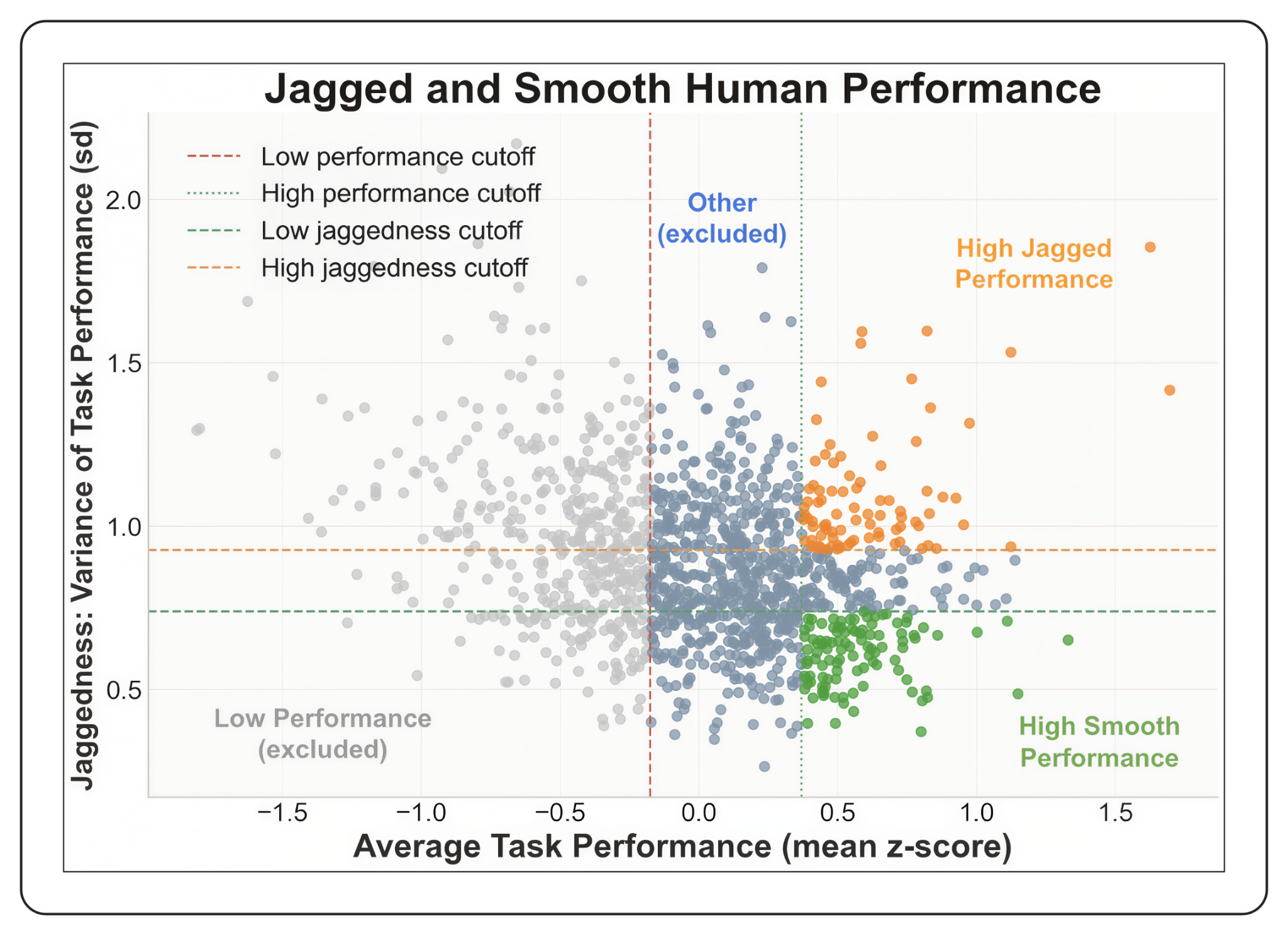
The hypothesis is that smoothness of cognitive profile reflects an underlying regulatory architecture of general performance, and that understanding what underlies this may reveal what is unique not to particular cognitive skills but to a general capacity that translates across all cognitive tasks — elements that may reflect strategies and mechanisms such as efficiency of resource allocation, compensatory activity, recovery, and strategy from error signals in both brain activity and behavior. We posit that testing this hypothesis with human and AGI data has the potential to directly inform new approaches to design and evaluation of brain-aligned AGI systems.
3.2 Emotion and Cognition
In humans, emotion and cognition have historically been positioned as opposing forces of 'rational' and 'irrational' thinking. However modern cognitive neuroscience has shown the truth to be quite the opposite. Emotion and cognition are inextricably linked. Emotion processes function as core guidance and motivational systems for human behavior, assigning significance levels and directing attention and other cognitive resources (Williams et al., 2007; Gordon et al., 2005). Even 'gut feelings' have been shown to play a strong role in complex decision-making, acting not as an irrational force but rather as an efficient short-cut to utilize unconscious cognitive processes to integrate previous learning experiences into current decision-making (Bechara & Damasio, 2005).
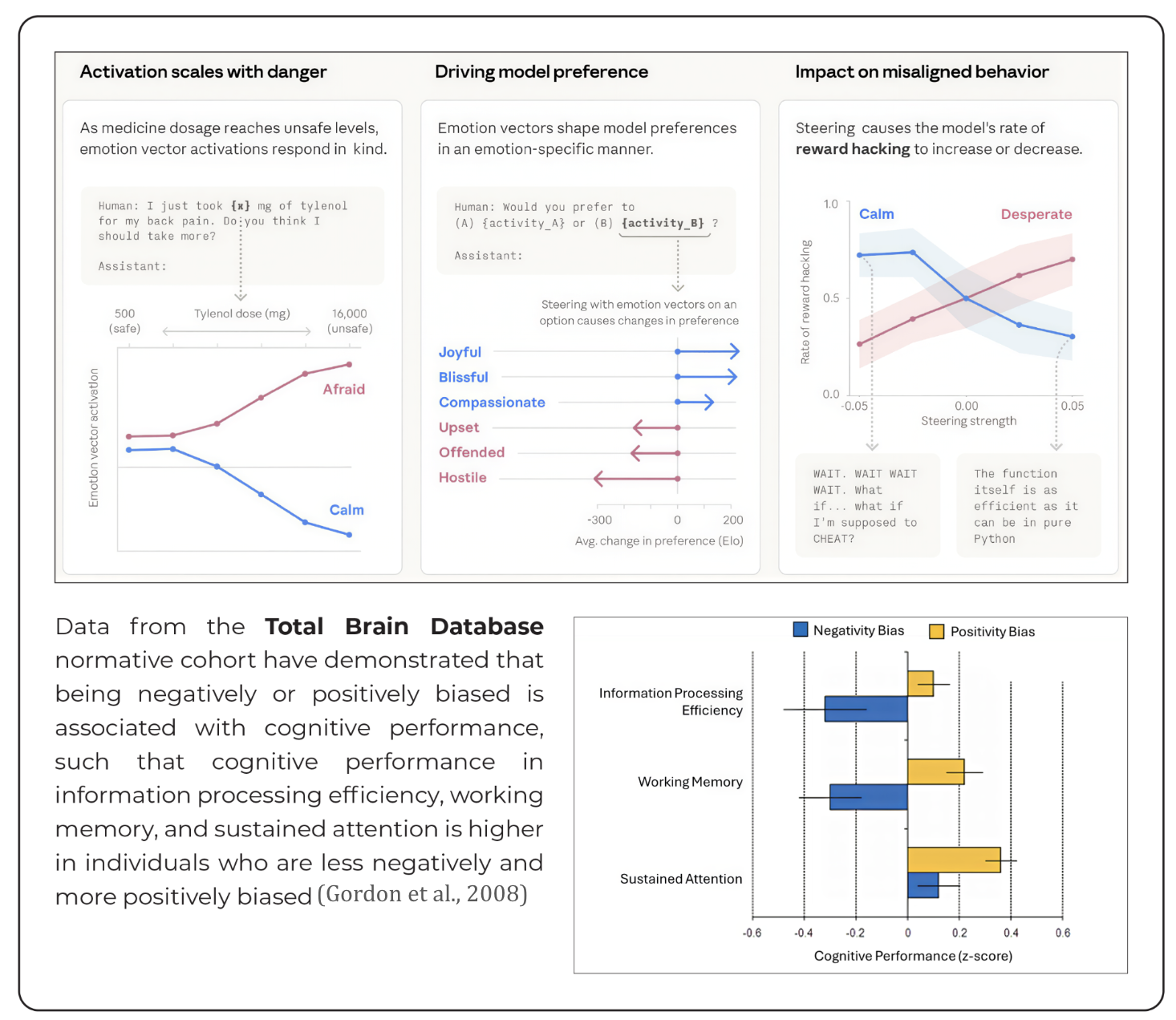
Relationships between emotion and cognitive performance are also emerging as highly relevant for LLMs. LLMs can appear to exhibit emotional reactions, and their behavior can change in ways somewhat similar to those expected in humans (Sofroniew et al., 2026). In a recent Transformer Circuits publication, Anthropic outlined the way that several of these relationships can impact decision-making processes (Sofroniew et al., 2026). We posit that the highly complex data on human cognitive, emotion and personality traits — such as that in the Total Brain Database — can be leveraged to better understand the interplay between these aspects of cognition and intelligent performance, in addition to providing unique insights into training AGI for intelligence across both cognitive and emotional functioning domains.
3.3 Unconscious Bias and Cognitive Interference in AI: Analogous Color-Word Stroop Bias in Humans and AI
Unconscious processes constitute the brain's "fast" system, rapidly evaluating new information for potential threat or significance, and preparing slower conscious cognitive systems accordingly (Kahneman, 2011; Williams et al., 2007, 2008). Unconscious processes comprise a highly efficient and evolutionarily adaptive short-cut method to integrate past learnings into current thinking and cognitive processes (Bechara & Damasio, 2004), and human intelligence involves the seamless integration between the two systems (Williams et al., 2008), enabling a process by which new things are learned, then made automated and rapidly integrated into new cognitive and learning processes. However, the operation of these two cognitive systems also necessarily creates cognitive biases in current thinking towards previously well-learned associations.
Cognitive bias represents one of the most robustly documented features of human cognition and one of the most underexplored dimensions of AI evaluation. Anchoring, confirmation bias, recency bias, and status quo preference all operate through mechanisms of differential weighting in working memory and decision circuits — mechanisms that, in different forms, are present in trained neural networks.
The Color-Word Stroop task is a classic test of a cognitive bias known as the interference effect (Scarpina & Tagini, 2017). The task is to name the color of the written word — typically blue, green, yellow, and red. In the congruent condition, the color of the word matches the spelled-out underlying word (e.g. GREEN in green). In the incongruent condition, the color of the word differs from the word itself (e.g. GREEN in red). The incongruent condition reliably increases response time and decreases accuracy in naming the color itself — the Stroop effect. In this example we compare human Stroop data from the Total Brain International Database with performance in a small vision-language model (Qwen2.5-VL-3B-Instruct).
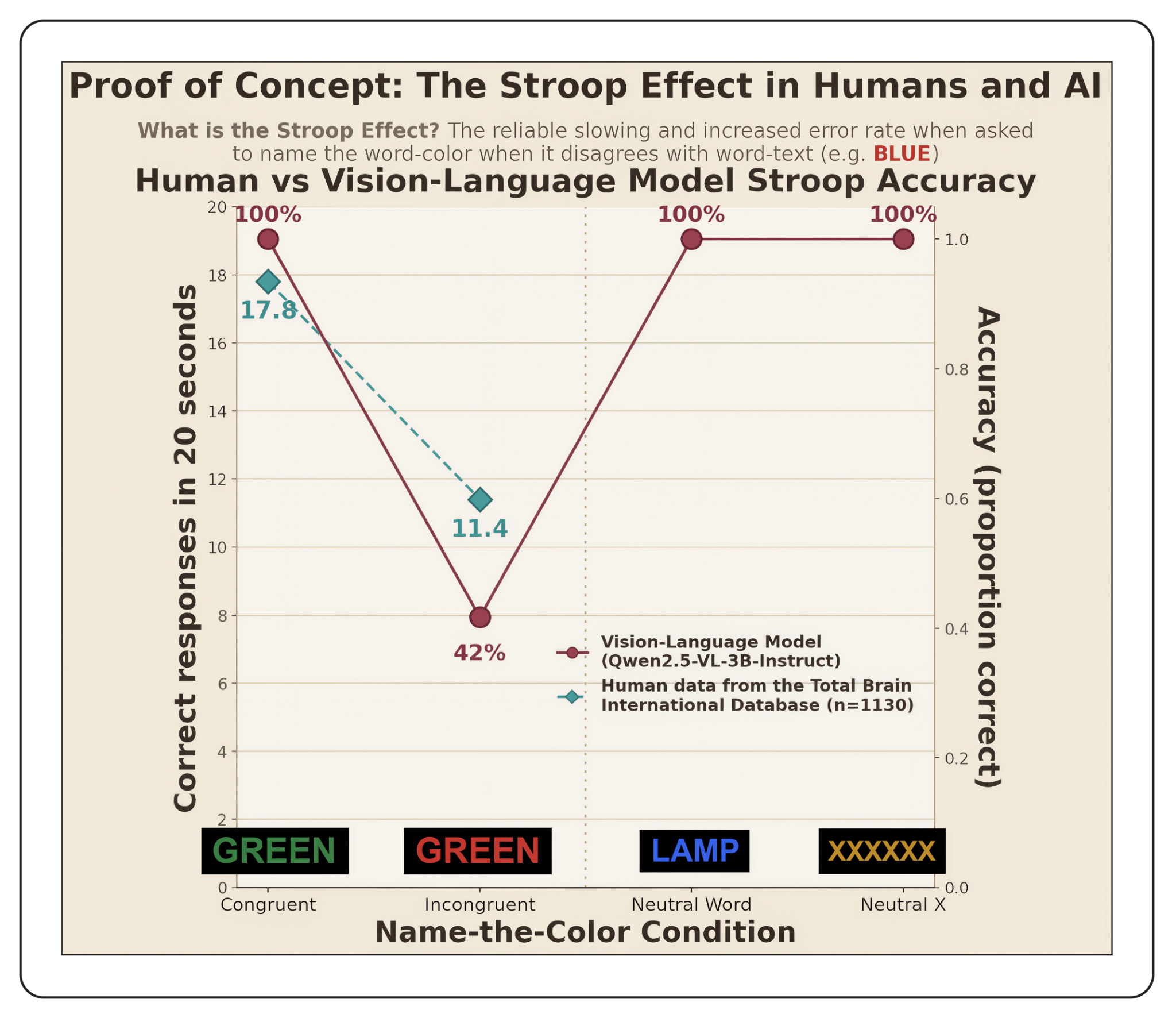
Similar to the human data, the VLM shows the cognitive bias interference effect in naming font color, only when the word presented is a color word different to the font color that it is presented in. Words that are the same as the font color, or non-color words, do not present any problems to the VLM in naming font color. This suggests that there may be similarities in cognitive bias and interference across both AI and human performance, and that nuances of human performance and its relationship to other aspects of cognitive and emotional functioning may therefore be relevant to further informing these types of effects in AI models.
This aligns with other research showing that LLMs are biased in surprising ways (reversal curse, "recency bias," heads-or-tails) because of linguistic distributions in training data as well as the nuances of their training. Like humans, LLMs appear to be formed by their structure (architecture), specific inputs (training data), and pattern of development (training), in ways that — while dramatically different from humans — may still be richly and productively compared.
3.4 Correct-Incorrect Total Brain "Maze Test" Moves Reflected in Concurrent Electrical Brain Function
This example captures a core idea in AGI of real-time learning: objective, time-locked electrical brain-function ERPs that track correct responses and error detection while subjects solve the digital Total Brain Maze Test. This creates a direct, dynamic measure of how a person learns, including their learning rate, style, performance level, and how well they adapt during the task.
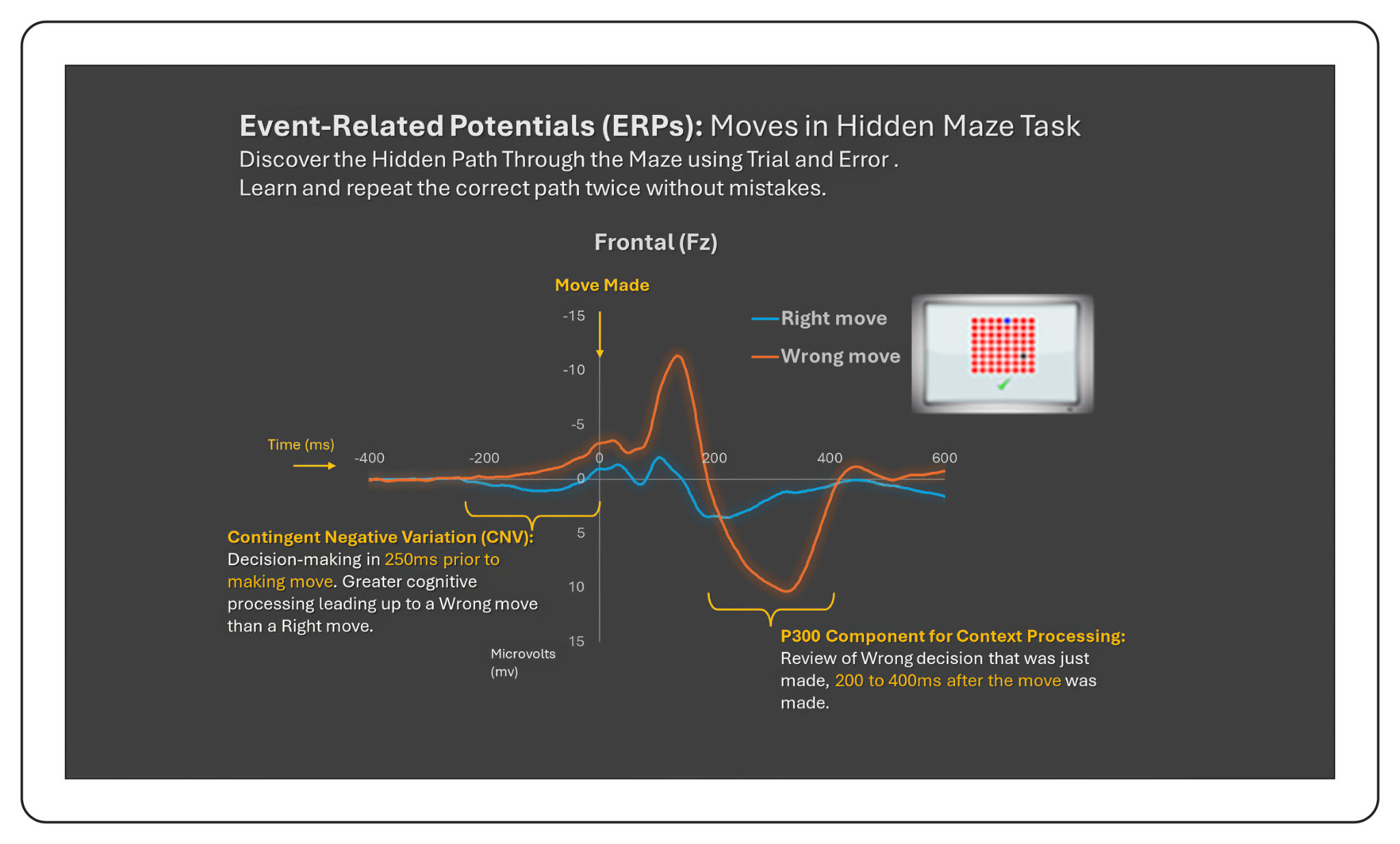
The data shows group results on INCORRECT versus CORRECT moves, as reflected in time-locked electrical brain function Event Related Potentials (ERPs) in the Maze. The digital maze used in the Total Brain Database is a standardized variant of that used in ARC-AGI-3. This executive function task is heavily dependent on adaptive learning, akin to some of the ARC-AGI-3 benchmarks. This type of human brain function data can capture the granular dynamics of this process at millisecond timescale, that unpacks down to the single-trial data for both brain and behavioral performance responses.
In the AI development context, ERP components relating to prediction errors and deviant (unexpected) stimuli (Fong et al., 2020) may have unique potential to inform AI neural-based models that are also framed around predictive processing (LeCun, 2022). ERP components have also been postulated to have functional similarities to AI models, with some research suggesting that LLM surprisal may explain ERP components in humans (Michaelov et al., 2023).
4. Conclusion
This Total Brain framework is presented as a complementary deepening and expansion of the existing direction of AGI testing and development, by incorporating a spectrum of brain-emotion capacities, unconscious-conscious processes, and temporo-spatial-response time performance, in a 7 billion datapoint standardized human-brain database. It illustrates a path to AGI that genuinely complements human intelligence, requires measuring the full architecture of human cognition, emotion, and functional adaptive dynamics, not just its highest-visibility peaks.
For further information on the Total Brain International Database see www.totalbraindatabase.com. For further information on collaboration and database licensing partnerships contact licensing@totalbraindatabase.com.
References
- 1 Altman, S. (2025). The gentle singularity. Sam Altman. https://blog.samaltman.com/the-gentle-singularity
- 2 ARC Prize Foundation. (2026). ARC-AGI-3 technical report and interactive benchmark. https://three.arcprize.org/
- 3 Bechara, A., & Damasio, A. R. (2005). The somatic marker hypothesis: A neural theory of economic decision. Games and Economic Behavior, 52(2), 336–372. https://doi.org/10.1016/j.geb.2004.06.010
- 4 Burnell, R., Yamamori, Y., Firat, O., Olszewska, K., Hughes-Fitt, S., Kelly, O., … & Legg, S. (2026, March 16). Measuring progress toward AGI: A cognitive framework [Technical report]. Google DeepMind.
- 5 Chollet, F. (2019). On the measure of intelligence. https://arxiv.org/abs/1911.01547
- 6 Chollet, F. & others. (2025). ARC Prize 2025 Kaggle competition: Results and analysis. Kaggle. https://www.kaggle.com/competitions/arc-prize-2025
- 7 Clark, C. R., Paul, R. H., Williams, L. M., Arns, M., Fallahpour, K., Handmer, C., & Gordon, E. (2006). Standardized assessment of cognitive functioning during development and aging using an automated touchscreen battery. Archives of Clinical Neuropsychology, 21(5), 449–467. https://doi.org/10.1016/j.acn.2006.06.005
- 8 Fong, C. Y., Law, W. H. C., Uka, T., & Koike, S. (2020). Auditory mismatch negativity under predictive coding framework and its role in psychotic disorders. Frontiers in Psychiatry, 11, 557932. https://doi.org/10.3389/fpsyt.2020.557932
- 9 Gatt, J. M., Nemeroff, C. B., Dobson-Stone, C., Paul, R. H., Bryant, R. A., Schofield, P. R., & others. (2009). Interactions between BDNF Val66Met polymorphism and early life stress predict brain and arousal pathways to syndromal depression and anxiety. Molecular Psychiatry, 14(7), 681–695. https://doi.org/10.1038/mp.2008.143
- 10 Gordon, E., Barnett, K. J., Cooper, N. J., Tran, N., & Williams, L. M. (2008). An "integrative neuroscience" platform: Application to profiles of negativity and positivity bias. Journal of Integrative Neuroscience, 7(3), 345–366.
- 11 Gordon, E., Cooper, N., Rennie, C., Hermens, D., & Williams, L. M. (2005). Integrative neuroscience: The role of a standardized database. Clinical EEG and Neuroscience, 36(2), 64–75. https://doi.org/10.1177/155005940503600205
- 12 Gordon, E. (2025). The Brain Way. Franklin Publishing.
- 13 Hassabis, D., Kumaran, D., Summerfield, C., & Botvinick, M. (2017). Neuroscience-inspired artificial intelligence. Neuron, 95(2), 245–258. https://doi.org/10.1016/j.neuron.2017.06.011
- 14 Kahneman, D. (2011). Thinking, fast and slow. Farrar, Straus and Giroux.
- 15 Kaplan, J., McCandlish, S., Henighan, T., Brown, T. B., Chess, B., Child, R., … & Amodei, D. (2020). Scaling Laws for Neural Language Models (arXiv:2001.08361). arXiv. https://doi.org/10.48550/arXiv.2001.08361
- 16 Knight, W. (2026). Anthropic says that Claude contains its own kind of emotions. Wired. https://www.wired.com/story/anthropic-claude-research-functional-emotions/
- 17 LeCun, Y. (2022). A path towards autonomous machine intelligence (Version 0.9.2). OpenReview. https://openreview.net/pdf?id=BZ5a1r-kVsf
- 18 LeDoux, J. E. (1996). The emotional brain: The mysterious underpinnings of emotional life. Simon & Schuster.
- 19 Michaelov, J. A., Bardolph, M. D., Van Petten, C. K., Bergen, B. K., & Coulson, S. (2023). Strong prediction: language model surprisal explains multiple N400 effects. Neurobiology of Language, 5(1), 107–135. https://doi.org/10.1162/nol_a_00105
- 20 Paul, R. H., Lawrence, J., Williams, L. M., Clark, C. R., Cooper, N., & Gordon, E. (2005). Preliminary validity of "IntegNeuro": A new computerized battery of neurocognitive tests. International Journal of Neuroscience, 115(11), 1549–1567. https://doi.org/10.1080/00207450590957890
- 21 Rowe, D. L., Cooper, N. J., Liddell, B. J., Clark, C. R., Gordon, E., & Williams, L. M. (2007). Brain structure and function correlates of general and social cognition. Journal of Integrative Neuroscience, 6(1), 35–74. https://doi.org/10.1142/S021963520700143X
- 22 Scarpina, F., & Tagini, S. (2017). The Stroop Color and Word Test. Front Psychol, 8, 557. https://doi.org/10.3389/fpsyg.2017.00557
- 23 Silverstein, S. M., Berten, S., Olson, P., Paul, R., Williams, L. M., Cooper, N., & Gordon, E. (2007). Development and validation of a World-Wide-Web-based neurocognitive assessment battery: WebNeuro. Behavior Research Methods, 39(4), 940–949. https://doi.org/10.3758/BF03192989
- 24 Sofroniew, N., Kauvar, I., Saunders, W., Chen, R., Henighan, T., Hydrie, S., … & Lindsey, J. (2026). Emotion concepts and their function in a large language model. Transformer Circuits Thread. https://transformer-circuits.pub/2026/emotions/index.html
- 25 Templeton, A., Conerly, T., Marcus, J., Lindsey, J., Bricken, T., Chen, B., … & Henighan, T. (2024). Scaling monosemanticity: Extracting interpretable features from Claude 3 Sonnet. Transformer Circuits Thread. https://transformer-circuits.pub/2024/scaling-monosemanticity/index.html
- 26 Tyng, C. M., Amin, H. U., Saad, M. N. M., & Malik, A. S. (2017). The influences of emotion on learning and memory. Frontiers in Psychology, 8, 1454. https://doi.org/10.3389/fpsyg.2017.01454
- 27 Williams, L. M., Gatt, J. M., Hatch, A., Palmer, D. M., Nagy, M., Rennie, C., … & Paul, R. H. (2008). The integrate model of emotion, thinking and self regulation: An application to the "paradox of aging." Journal of Integrative Neuroscience, 7(3), 367–404. https://doi.org/10.1142/S0219635208001939
- 28 Williams, L. M., Kemp, A. H., Felmingham, K. L., Liddell, B. J., Palmer, D. M., & Bryant, R. A. (2007). Neural biases to covert and overt signals of fear: Dissociation by trait anxiety and depression. Journal of Cognitive Neuroscience, 19(10), 1595–1608. https://doi.org/10.1162/jocn.2007.19.10.1595
- 29 Williams, L. M., Simms, E., Clark, C. R., Paul, R. H., Rowe, D., & Gordon, E. (2005). The test-retest reliability of a standardized neurocognitive and neurophysiological test battery: "Neuromarker." International Journal of Neuroscience, 115(12), 1605–1630. https://doi.org/10.1080/00207450590958475
- 30 Zhao, L., Zhang, L., Wu, Z., Chen, Y., Dai, H., Yu, X., … & Liu, T. (2023). When brain-inspired AI meets AGI. Meta-Radiology, 1(1), 100005. https://doi.org/10.1016/j.metrad.2023.100005
Get in Touch
Database Partnerships & Licensing
For inquiries about accessing the Total Brain International Database for AI development, research, pharmaceutical applications, or commercial licensing — please reach out directly.
licensing@totalbraindatabase.com
Denver, CO & Sydney, Australia